Showing posts with label Nepal. Show all posts

Wednesday, October 10, 2012

BHAKTAPUR

A Nepalese child watches from windows built hundreds of years ago.
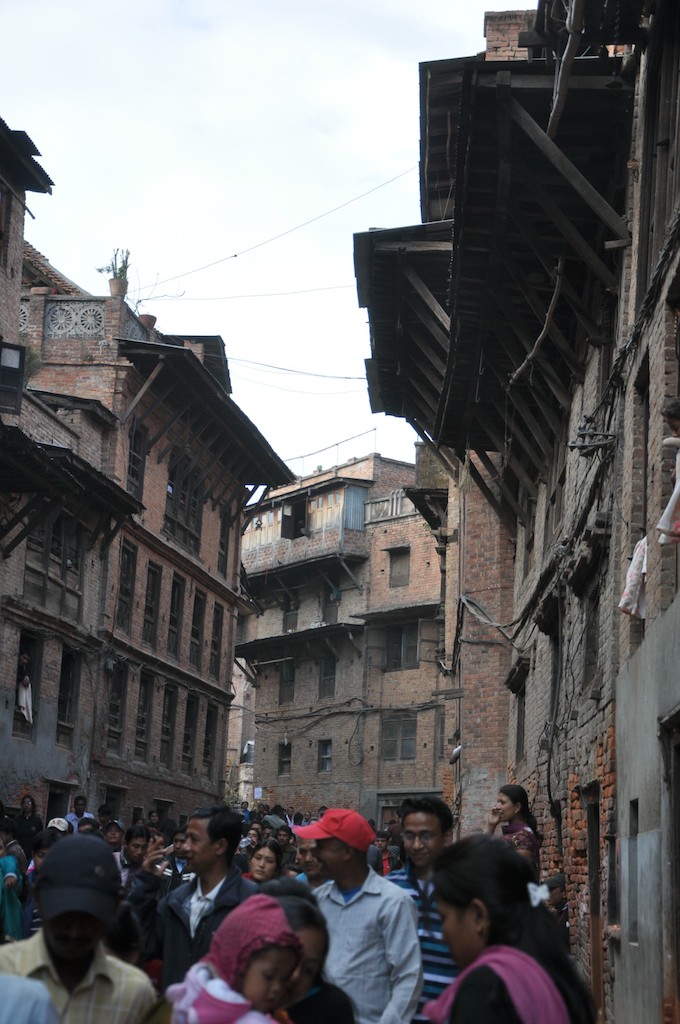
Located 13kms from Kathmandu, in Nepal, Bhaktapur is a world heritage site. It was built between the 13th and the 17th centuries. The city contains a mixture of ancient Nepalese and Indian architecture. Wandering around the streets you get glimpses of what life was like hundreds of years ago. The architecture, the temples, the paved street even the old well, all must have amazing stories to tell.

Cars are banned from the cobbled streets.
The city lies on an ancient caravan trade route between Tibet and India, and because of this became wealthy and prosperous. The numerous temples, artworks and old buildings built centuries ago attract tourists and the devout to Bhaktapur every day. The temples are mainly Hindu. The wood, metal and stone artworks adorn buildings and line streets, and the architecture is a mixture of Nepalese and Indian culture. To help preserve the site cars are banned from the cobbled, overhanging streets. Bhaktapur is known for its pottery and for its yoghurt or curd Ju-Ju Dhau, which is sold in small clay bowls.

Religious building contribute to the artworks of the city.
The ancient name for Bhaktapur is 'Khwopinggram'. The name Bhaktapur comes from Sandkrit Nepali and means "the town of devotees'. At times it is also referred to in the Kathmandu Valley as Khwopa, Bhadgaon or the 'Ancient Newari town'.


One of the most exciting annual events in Bhaktapur is the festival of Bisket Jatra. This festival lasts for several days and its end signifies the beginning of the Nepali New Year. As part of the festival villages hauling a symbolic chariot through the city. The chariot is huge and ponderous, swaying from side to side and creaking as it lumbers along the cobbled streets. It carries the images of the god Bhairab. At one point it stops and there is a fiercely contested tug-of-war over the chariot by villagers from the west side of town against villagers from the east side of town. It is considered that the god will bestow a blessing for the coming year on the side of town which is victorious in the tug-of-war.

After the chariot is dragged into the centre of the town there is a huge, 25 metre, phallic symbol erected. This is eventually pulled down, again in a tug-of-war, to symbolise the start of the New Year. The festival takes place from the 12-15th April each year.


Some of the ancient building are in need of repair.


In Nepal ancient cultures and new have blended together.


Spectator sit on the steps of this temple.
The phallic symbol is pulled down to start the New Year
My grand-daughter, Eve was a hit with locals
The crowd dragging the chariot

Youths climb to the front of the chariot urging the crowd on.

Large ropes are used to drag the chariot, while other villagers push the wheels and the rear .

The chariot is slowly moved into the centre of the town.


Saturday, October 30, 2010

FESTIVAL OF NEPAL

On Saturday 4th September 2010 the flag of Nepal flew proudly over Tumbalong Park at Darling Harbour in Sydney. The Nepal festival is held every two years, however this year was particularly significant as it marked the 50th anniversary of diplomatic relations between Australia and Nepal. The festival aims not only to promote Nepal and Nepalese culture, but also helps to promote a sense of community amongst Nepalese people living in Australia.

The festival is jointly organised by the Non-Resident Nepali Association Australia (NRN), the Embassy of Nepal in Canberra, Nepalese Consulate Offices in NSW and Victoria and various Nepalese community organisations. While food is a big feature on the day there are also musical items, dancing, business information and an expo of Nepali culture. This year rain threatened to make the festival a washout, however after a slow start the crowd grew to near capacity spilling out of the park. A similar event will also be held in Brisbane on 11 September and in Melbourne on 20 November.

The festival was presided over by the President of the NRNA, Mr Dhuba. Official guests included MP Laurie Ferguson representing the Australian government, and my old friend Tony Stewart, representing the State government. Tony himself has been trekking in Nepal years ago.

The food was typically Nepali and I was very pleased to see a stall organized by the Gorkha Palace restaurants. It was good to have a feed of momos here and reminded me of making these at the children's home in Nepal. The Gorkha Palace restaurants are a favorite of mine and are located on Victoria Road at Gladesville and on Concord Road at North Strathfield. My good friend Saldap Lamichhale always makes you feel welcome and serves terrific, authentic Nepali food.


It was good to see traditional Nepalese dress being worn on the day and this added to the atmosphere. Dancers performed traditional dances as well as modern dances, but the highlight for many was the band 1974 AD who came all the way from Kathmandu. By the time they performed the crowd had swelled to some 20,000 people filling the park. There are a number of videos on You Tube showing the band in action.

One interesting stall in the park belonged to NetFox and MyTVchannel who are providing Nepali television channels in Australia.

Youngster are dressed in 'typical Nepalese spiderman' outfits.

Here I am pictured with another good friend, Narayan Mainali who was the Under Secretary in Canberra until recently returning to Nepal. Narayan had invited me to the festival.

Nepal is the only country in the world which has a flag which is neither square nor rectangular. Until 1962 the flag had human faces on it but these were replaced by a stylised moon and sun based on ancient Hindu symbols. The red colour of the flag represents the colour of the rhododendron(Nepal's national flower) and symbolises victory and bravery, while the blue border symbolises peace and harmony.

Sunday, April 25, 2010

NEPAL

Last November I took my first trip outside of Australia. With my daughter, Amanda I travelled to Nepal and for seven weeks did volunteer work at the Everest Children's Home and then a monastery. From the moment we stepped off the plane it was confronting. The area around the airport looked like a bomb had demolished everything. Not a house looked complete or livable. People were dressed in dirty clothes and beggars knocked on the cab window. As we spent time there we realised that although there was poverty everywhere in Nepal that area was probably the worst. We saw people living on the street or in houses made from sticks and hessian. They ekked out a living any way that they could. However I also noticed something else: people were always smiling and laughing and happy.

The experience in Nepal was life changing. I am not sure how yet, but I know it was. I had two important thoughts. Firstly, how could countries which purport to be world leaders, and caring, christian nations let fellow human beings live in conditions such as this. The second, how resolute the human spirit is. Many Nepalese people live in poverty but they don't complain. They get on with life and smile and joke and laugh.

Nepal is one of the world's smallest and poorest countries. It is 853km long and 225kms wide at its widest (average 160kms wide). It starts at 91metres above sea-level and rises to 8,882 metres. It contains 9 of the world's highest 14 mountains over 7,925 metres, including Everest and Annapurna. Less than a third of the country is suitable for farming.By 2020 the population is expected to be about 34 million. In the 1960s 1 in 3 babies died and the life expectancy was just 29, today life expectancy is over 56.

It was a medieval feudal country up until the ruling Rana government was ousted in 1951. Before this time it wasn't open to tourists or outside visitors. In fact between 1796 and 1950 there are only 130 official visitors to the country recorded. The first group of tourists were in 1955. The country was really opened up in the 1960s by hippies who came for the free drugs and the easy lifestyle. Many lived in Kathmandu in tents, on what is known as Freak Street.

Prithvi Naraya Shah, a king of the House of Gorkha united the country in the second half of the 1700s. There are still older hill people who still do not realise their country is called Nepal.....they think Nepal is a small valley near Kathmandu. Only about 1/5 of the country gets electricity, and these suffer from regulkar blackouts, as we have found out. There is no centralised medical system or public works. However there is very little crime. There is pollution and smog....this comes from cement works, marble quarries and cheap petroland diesel....and causes a lot over dust over everything each day.

Nepal is also the world's only Hindu Kingdom. Hindu, Buddhism and to a lesser extent Christianity all blend together, but religion is very important and seems to permeate through everyday life.

If I had been asked 12 months ago to make a list of the countries i like to visit overseas Nepal would probably not have featured, now it probably heads the list. I think of it as a truly wonderful country, full of contrasts and wonderful people. If you would like to see more about Nepal, or about our adventures there then go to our blog: sevenweeksinnepal.blogspot.com


Sunday, March 28, 2010

SIGNS OF THE MODERN WORLD

This was my favourite sign in Nepal.


Of course this ran a close second....but for other reasons.

I had to look twice as I passed this house in Sydney. That's right....its a dentist. Have a close look at the lights. Yep, they are little teeth!!

This picture was shamelessly 'borrowed' from another blog. A very good blog, Keetha Stuff 'N Such, give it a visit.

Another picture from Nepal. Learn to be a pilot for Christmas.....was I tempted? What do you think?

I like this sign near Narrandra. Eversince I have first seen it I have wanted to make another sign to hang under it. The new sign would read: "but in the daytime they are happy!"

Monday, March 22, 2010

MAKING A DIFFERENCE

When I first began teaching I would attend professional development activities and inevitably you would be asked to write down why you were a teacher. Or to put it another way, what was your philosophy of teaching. You were usually given half an hour or so to do this at the start of the day..... which was coincidentally, convenient because it gave the presenter half an hour to get organised. You would sit there for half an hour trying to think of some answer so you could appear brilliant if called upon to read it out. I would wonder whether I was game enough to tell them I finished school and didn't know what to do when someone suggested teaching and mentioned you could get a scholarship to go to university. I would look around and see how the serious people were furiously filling their papers with their views on 'truth, justice and the department of education way'. Then I would revert to doodling or drawing cartoons. See I was keen, very keen but I just didn't have a philosophical vision or a star to steer myself by. I expected to develop this as I learnt my trade.

I began as a History and Special Education teacher. 'Special Education'! This was because I didn't want to teach English. My first practical session was at a high school in Sydney. I taught some History and hang around with the Special Education class. The star pupil was Stephen. He was 14 years old and had not spoken until he was about 9. The high school had a program where he would take messages around the school and this would encourage him to interact with staff and students. This program had been running for over a year so when Stephen appeared at the staffroom door with a note I opened it and read:

This note is of no consequence whatsoever. Just sign the bloody thing and send Stephen on his way.

During the two weeks I was there the class were learning how to cook peas and eat them. They had been doing this for nearly a term. They had coloured-in stencils of peas, grown peas, written stories about peas, and even made little felt pencil cases which looked like a pea pod.... complete with smiling little peas inside when you opened the zipper. During one lesson they had discussed how to cook peas and they had written out the method and had a look at the equipment needed. Now was the big day. A double lesson in which they got to cook and eat their peas. I had a history class during the first period and so at the break went down to the kitchen. Most of the kids were sitting eating their peas. But Stephen was in the corner huddled over the sink. I went over to him and found he was stuffing peas down the plug. "No, Stephen" I said "You are allowed to eat them". He paused long enough to turn and tell me in no uncertain terms "I don't even like spinach".

But Stephen was an expert in other things. He probably knew more about dinosaurs then all the teachers there put together. He could pronounce the names of dinosaurs that we had never heard of. He could tell you when they lived, what they ate, what size they were and how much they weighed. He was so good that the teachers would get him to give a talk to the year 7 classes when they were studying dinosaurs. This also built up Stephen's confidence.

Teaching Special Education taught me a lot. A lot which shaped the way I taught and also transferred over into mainstream classes. It also shaped my 'philosophy' of why I teach. It can best be summed up by a story I once heard:

A famous American writer/philosopher was walking along a huge beach and there were millions of star fish washed up on the beach by a storm. As he walked along he saw a young man pick up a star fish and throw it back into the ocean. He watched for a while as the man picked up another and threw it into the ocean also. He walked up to the man and said "there are millions of them you can't make a difference". The young man paused, but then bent down, pick up another and walked to the water's edge and threw it into the ocean. He came back to the writer and said "it made a difference to that one".

I have already mentioned the Everest Children's Home in Nepal where my daughter, Amanda and I were doing volunteer work. When I returned home she stayed and did an extra month with the kids. In Nepal she spent all the money she possessed on the kids, including hiring them a tutor to try bring their grades up at school. She has also been trying to raise the money to send all of the children to private school as this will help them get a better start in life (there is a big difference in a government and a private school in Nepal). It cost so little to send these kids to school, around $400 a year per child. Amanda has done a fantastic job and there are only 6 kids left to find money for. Of course this won't solve the orphan problem in Nepal....but like the starfish.....it will make a difference to them. The pictures on this post are the children from the Everest Children's Home.

Tuesday, February 16, 2010

LIFE IN THE MONASTERY


Last November I took my first trip outside of Australia. My daughter, Amanda and I spent seven weeks in Nepal doing volunteer work, first at the Everest Children's Home and then at the Pema Ts'al Sakya Monastic Institute. The time at the monastery I found fantastic, amusing and so surreal. We taught classes, had classes in Buddhist philosophy, attended prayer sessions, ate with the monks, talked with the monks, laughed with monks, even danced with the monks and for a short while experienced life in the monastery.
(see sevenweeksinnepal.blogspot.com)

A little history of the monastery. Its located in the village of Hyangja, just outside of Pokhara. It was first established in 1999 in Kathmandu with 30 children, 25 of these were from the different villages of the district of Mustang (the people who are ethnic Tibetans) and five from Tibetan refugee camps around India and Nepal. In February 2002 in was moved to its present location near Pokhara, and in 2004 added 25 more students again from Mustang and Buddhist communities in Nepal. At present there are about 80 students but the monastery aims to accommodate 105 students eventually. The institute also caters for blind students who are taught using the newly invented system of braille pioneered at their sister school in Mundgod in India. Lama Kunga was formerly appointed chairman of Pema Ts'al in 1997.

The Kingdom of Mustang, where the children are drawn from, is one of the smallest Buddhist Kingdoms. It is located to the northwest of Nepal and surrounded on three sides by Tibet. Until recently it was one of the most isolated and inaccessible areas of the world. While its social and spiritual life has remained unchanged for centuries it lost its spiritual patronage from Tibet in 1959. The institute seeks to in part fill this void and preserve cultural identity and the Buddhist way of life.


The monastery is under the care and guidance of Lama Kunga. While there I was to teach him english. It was such a surreal experience each night to be in his room reading Goldilock and the Three Bears and trying to explain to him why she was called Goldilocks. He was so caring towards the young students and he had a great sense of humour. This was evident the night we returned late from shopping in the city to find he had locked us out of the monastery and wouldn't let us in until he had lectured us about being late .

While there we had the occasional Buddhist philosophy lesson. In one of these we talked about all life being sacred and how buddhists didn't eat meat, nor did they kill anything. Not even an insect. I saw this in practice one night in the dining hall when a mosquito landed on my arm. I made a swipe at it but missed and slapped my arm. It was like a scene from the movies. I felt like almost immediately eigthy faces turned to look at me and a dead silence descended on the place. Lucky I missed it.


One night I was called to remove a cockroach from the room the two female Dutch volunteers were staying in. Ronne and Eva were final year medical students and used to dealing in blood and body parts but Ronne just could not stand even the sight of cockroaches. The next morning the three of us attended the early morning prayer session held just before dawn. We would sit cross-legged on little benches around the side of the prayer room. Maybe it was divine intervention but in the middle of the prayer session a cockroach scuttled into the centre of the room. It stopped, slowly turned towards us, and then slowly scuttled closer and closer. It stopped just in front of us and sat there watching for about fifteen minutes before advancing to below our feet and then following the bench along to the door. Ronne was biting her lip trying not to scream. I was biting my lip trying not to laugh. I think the cockroach was just licking its lips and I'm sure it had a little grin.