Showing posts with label festival. Show all posts

Sunday, October 14, 2012

GUINEA PIG RACES


Situated in the Weddin Shire in central New South Wales is the historic township of Grenfell. Many of the buildings of the main street support lacework and veranda posts, which give the town a relaxed country charm. Originally known as Emu Creek, it is the birthplace of one of Australia’s most famous poets and short-story writer Henry Lawson. Grenfell celebrates its famous son every June long weekend with the holding of the Henry Lawson Festival of Arts. The festival includes poetry and drama, craft and photography exhibitions, a street parade and carnival, go-kart races, wood chopping events and food and wine in abundance. However the highlight of the festival, for me, is the Guinea Pig Race Meeting.

The start of one of the sprint races with competitor getting a little encouragement.
About 30 minutes out of Grenfell is the only registered guinea pig racing club in the world: the Pinnacle Guinea Pig Racing Club. It has its own facilities and its own racetrack. There is a stadium with tiered seating, and a racetrack where guinea pigs compete in the sprint or hurdle races. The club holds an annual race meetings on the Sunday of the June long weekend. The race meeting is conducted by volunteers and all money raised goes to local charities. 

The 'gentry' picnic in the carpark.
The race meeting attracts visitors from around the world and across Australia. When I attended there was a couple who had travelled from America just to attend the race meeting they had heard so much about. There were also visitors from Western Australia and South Australia as well as all the eastern states. Although ‘country dress’ is the most popular, there were many who took the excuse to dress in their finest race-day fashions. Many groups also produced the bubbly and picnic spread beside the land rover in the carpark which gave the event an atmosphere probably only rivaled by the Melbourne Cup.

The hopeful 'Master of Ceremony'.
There were a number of events during the day. Bookies took bets, though these were often for only 50 cents or a dollar and usually paid 2 to 1 no matter whether the winner was a favourite or a complete outsider. Most of the owners appeared to be children, but I am sure this was only a tactic by ruthless guinea pig owners and serious trainers to lull their opponents into underestimating them. The races began at a furious pace, with the guinea pigs being followed by the young owners, and the official course motivator, encouraging bewildered animals to run the complete length of the track.

The stadium.
In all it was a fun day with a real family and country atmosphere. The event was made even more entertaining by the female 'master of ceremonies', dressing fashionably in painted gum boots and a fur coat, and the male race-caller as they tried to find a date for the 'mc' from all the single men in the crowd. This led to much embarrassment from the single men and terrific crowd participation and laughter. It is a country event that needs to be experienced at least once, but for which you will return time and time again.


'The bookie'
'The encourager'


An obvious guinea pig talent scout.
A young owner.


Gold and silver guinea pig trophies.


Wednesday, October 10, 2012

BHAKTAPUR

A Nepalese child watches from windows built hundreds of years ago.
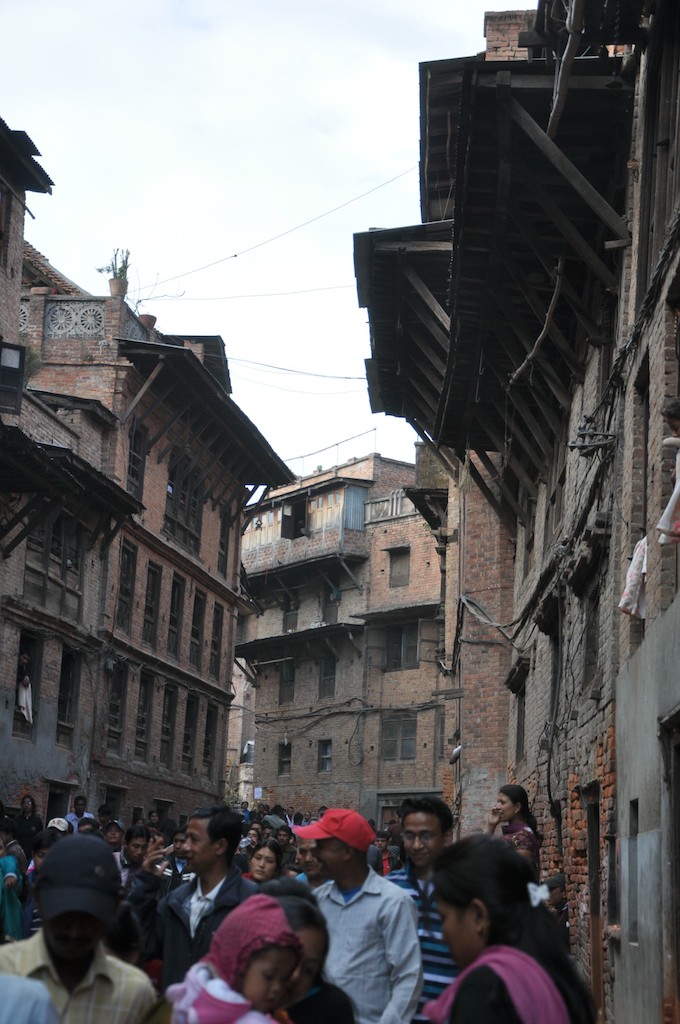
Located 13kms from Kathmandu, in Nepal, Bhaktapur is a world heritage site. It was built between the 13th and the 17th centuries. The city contains a mixture of ancient Nepalese and Indian architecture. Wandering around the streets you get glimpses of what life was like hundreds of years ago. The architecture, the temples, the paved street even the old well, all must have amazing stories to tell.

Cars are banned from the cobbled streets.
The city lies on an ancient caravan trade route between Tibet and India, and because of this became wealthy and prosperous. The numerous temples, artworks and old buildings built centuries ago attract tourists and the devout to Bhaktapur every day. The temples are mainly Hindu. The wood, metal and stone artworks adorn buildings and line streets, and the architecture is a mixture of Nepalese and Indian culture. To help preserve the site cars are banned from the cobbled, overhanging streets. Bhaktapur is known for its pottery and for its yoghurt or curd Ju-Ju Dhau, which is sold in small clay bowls.

Religious building contribute to the artworks of the city.
The ancient name for Bhaktapur is 'Khwopinggram'. The name Bhaktapur comes from Sandkrit Nepali and means "the town of devotees'. At times it is also referred to in the Kathmandu Valley as Khwopa, Bhadgaon or the 'Ancient Newari town'.


One of the most exciting annual events in Bhaktapur is the festival of Bisket Jatra. This festival lasts for several days and its end signifies the beginning of the Nepali New Year. As part of the festival villages hauling a symbolic chariot through the city. The chariot is huge and ponderous, swaying from side to side and creaking as it lumbers along the cobbled streets. It carries the images of the god Bhairab. At one point it stops and there is a fiercely contested tug-of-war over the chariot by villagers from the west side of town against villagers from the east side of town. It is considered that the god will bestow a blessing for the coming year on the side of town which is victorious in the tug-of-war.

After the chariot is dragged into the centre of the town there is a huge, 25 metre, phallic symbol erected. This is eventually pulled down, again in a tug-of-war, to symbolise the start of the New Year. The festival takes place from the 12-15th April each year.


Some of the ancient building are in need of repair.


In Nepal ancient cultures and new have blended together.


Spectator sit on the steps of this temple.
The phallic symbol is pulled down to start the New Year
My grand-daughter, Eve was a hit with locals
The crowd dragging the chariot

Youths climb to the front of the chariot urging the crowd on.

Large ropes are used to drag the chariot, while other villagers push the wheels and the rear .

The chariot is slowly moved into the centre of the town.


Sunday, March 20, 2011

ELVIS

An Elvis family from Melbourne.

The town of Parkes is located in the central west of NSW. It has a population of approximately 15,000 people. It is well known as the home of the Dish, that is, the telescope which tracked the Apollo landing on the moon. It is not so well known for holding the World Marble Championships. However each year in early January the population of the town swells dramatically, this year to almost double, for the annual Elvis Festival.

Some fans just couldn't help themselves.

The Elvis Festival was conceived by a small group of Elvis fan who thought that it might be a good way to celebrate Elvis' birthday each year. It began humbly as a one night event for about a hundred people. By the year 2000 it had grown to a day-long festival. Gradually more events were added and in 2005 over three and a half thousand people attended.

No effort was spared.

This year the festival was held over five days from the 5 to 9 January. It involved over 140 events and attracted a record crowd, doubling the town's population. Fans came from every state in Australia and as far away as New Zealand, Italy and the USA. Besides a street parade, other events included an Elvis Gospel service, the 'Back to the Altar with Elvis-Renewal of Wedding vows', dinner with Miss Priscilla and an Elvis Poet's breakfast.

Some Elvises were very young.

At this year's festival there was an attempt to regain the Guinness Book of Records' title for the most Elvis impersonators gathered together. In 2007 147 impersonators gathered in Parkes to break the previous record of 78. Recently a new record was set at 645 in Las Vegas. Unfortunately the Parkes attempt fell just short with 610 impersonators, but this gives organisers something to promote for next years festival.

Some Elvises were very good. This was the winner of the Elvis impersonators competition.

The town of Parkes has its own Elvis fanatics. One local has changed their name to Elvis by deed poll. There is a Gracelands restaurant, an Elvis memorial and an Elvis museum. For the festival there is also a special Elvis Train which brings fans from Sydney to the event.

Nearly fifty couples took the chance to renew their wedding vows. This couple had been married for 50 years.

Many fans enjoyed the chance to dress in costumes from days gone by.

There was lots of dancing.

....and lots of cars.

.....but just one Indian. (When I asked him why, he said "well everyone else was dressed as Elvis!" )

Saturday, October 30, 2010

FESTIVAL OF NEPAL

On Saturday 4th September 2010 the flag of Nepal flew proudly over Tumbalong Park at Darling Harbour in Sydney. The Nepal festival is held every two years, however this year was particularly significant as it marked the 50th anniversary of diplomatic relations between Australia and Nepal. The festival aims not only to promote Nepal and Nepalese culture, but also helps to promote a sense of community amongst Nepalese people living in Australia.

The festival is jointly organised by the Non-Resident Nepali Association Australia (NRN), the Embassy of Nepal in Canberra, Nepalese Consulate Offices in NSW and Victoria and various Nepalese community organisations. While food is a big feature on the day there are also musical items, dancing, business information and an expo of Nepali culture. This year rain threatened to make the festival a washout, however after a slow start the crowd grew to near capacity spilling out of the park. A similar event will also be held in Brisbane on 11 September and in Melbourne on 20 November.

The festival was presided over by the President of the NRNA, Mr Dhuba. Official guests included MP Laurie Ferguson representing the Australian government, and my old friend Tony Stewart, representing the State government. Tony himself has been trekking in Nepal years ago.

The food was typically Nepali and I was very pleased to see a stall organized by the Gorkha Palace restaurants. It was good to have a feed of momos here and reminded me of making these at the children's home in Nepal. The Gorkha Palace restaurants are a favorite of mine and are located on Victoria Road at Gladesville and on Concord Road at North Strathfield. My good friend Saldap Lamichhale always makes you feel welcome and serves terrific, authentic Nepali food.


It was good to see traditional Nepalese dress being worn on the day and this added to the atmosphere. Dancers performed traditional dances as well as modern dances, but the highlight for many was the band 1974 AD who came all the way from Kathmandu. By the time they performed the crowd had swelled to some 20,000 people filling the park. There are a number of videos on You Tube showing the band in action.

One interesting stall in the park belonged to NetFox and MyTVchannel who are providing Nepali television channels in Australia.

Youngster are dressed in 'typical Nepalese spiderman' outfits.

Here I am pictured with another good friend, Narayan Mainali who was the Under Secretary in Canberra until recently returning to Nepal. Narayan had invited me to the festival.

Nepal is the only country in the world which has a flag which is neither square nor rectangular. Until 1962 the flag had human faces on it but these were replaced by a stylised moon and sun based on ancient Hindu symbols. The red colour of the flag represents the colour of the rhododendron(Nepal's national flower) and symbolises victory and bravery, while the blue border symbolises peace and harmony.