Sunday, December 5, 2010

SCULPTURES BY THE SEA.

"Tide's turn" by Peter Collins (NSW)

Sculptures by the Sea is the world's largest outdoor art exhibition. It evolved from an idea conceived by David Handley as he "played" amongst the ruins and art works of an outdoor sculpture park near the town of Klatovy, Bohemia in the early 1990s. David's idea grew and he was able to gain the support of artists and local councillors to run a one day event which attracted nearly 25 thousand people. This first event was organised over a ten week period in 1997. It attracted nearly one hundred artists and was run on a budget of $11,000.

"What have they ever done for us" Sasha Reid (NSW)

This year, during the 14th Sculptures by the Sea exhibition, over 100 sculptures of all shapes and sizes were laid out along the walkway from Bondi to Bronte. Artists from all across Australia and from eleven other countries, exhibited their work and competed for prizes. The exhibition has become a popular community event is expected to attract nearly half a million visitors.

"Mirroring 1995" Keld Moseholm (Denmark)

The prize of $60 000 went to the 75 year old Danish artist, Keld Moseholm. Moseholm has been showing his work in exhibitions in Europe and the USA for over 20 years. His prize winning work, "Mirroring 1995" showed two rotund figures engaged in a tug-o-war through a mirror. The work stands more than a metre high and is cast in bronze on a granite plinth.

"The Adaptable Migrant" Suzie Bleach & Andy Townsend (NSW)

The $5 000 Allens Arthur Robinson's People's Choice award was given to artists Suzie Bleach and Andy Townsend for their joint work "The Adaptable Migrant". This was a life-size steel camel. The camel had various objects in its stomach which were used and fondly remembered by migrants to Australia. These included a singer sewing machine, a ukulele, and a number of books.

"Bureaucratic tank" Edward Horne (NSW)

Another favourite was the life size army tank made from disused office equipment. The tank was created by artist Edward Horne and called "Bureaucratic tank". The statement in the catalogue really sums up this piece: "Bureaucracy is like a military tank. It won't stop for humanitarian values. It leaves a path of paper wherever it goes."

"Globoids" Marcus Tatton (Tasmania)

The average cost for an artist to create, transport and instal their work at the exhibition is approximately $13 000. This obviously varies with materials used, size of the sculpture and the distance it has to be transported, as well as the number of hours the artist has to put into creating their work. Japanese sculptor, Zero Higashida, is reported to have spent about four months creating his work "Portrait of Mr A", which was inspired by playwright Edward Albee. Victorian sculptor, Andrew Rogers was one of the first to sell his work this year. His piece "From optimism to hope", consists of three large flowers made of 24 carat gold leaf, stainless steel and bronze. The work took Andrew approximately half a year to complete. It has now been purchased by Canberra Airport at a price of $160 000.

"Splash" Tomas Misura (NSW)

There has been some controversy surrounding this year's exhibition. Many of the sculptures showcased are sold and the practice in the past has been to split commissions on these sales 50/50. However with tougher economic times it has been more difficult for organizers of the event to attract sponsorship. David Handley this year announced that the split would be 75/25, in favour of the organizers. It was claimed that this announcement was left until the last moment so that artists still felt obliged to display their work. It is claimed that four artists did pull their work from the show and that next year as many as 20 artists may boycott the event.

One of the figures from "Weeping Weeds" Jennifer Orchard (NSW)

While there was also some criticism of the sculptures this year overall the event achieved its aims despite difficult weather impacting on crowds. It has certainly made art and sculpture topical. It has brought sculpture to many people who might never look at or think about this art form, and it has continued to promote art as a topic for discussion. The fact that it still draws huge crowds to the exhibition each year makes it a major tourist attraction for Sydney.

"Lumphead" Fredrik Raddum (Norway)


Monday, November 22, 2010

JAPANESE FILM FESTIVAL

Last night I attended the Opening Night Gala of the Japanese Film Festival as a guest of Mr Masanori Ohtani. It was the 14th time this annual event has been held. A launch was held in the foyer of the Sydney event centre, George St. After speeches from directors, critics and organisers, the party moved into the main theatre where a near capacity crowd saw the screening of the movie: About Her Brother.

About Her Brother was directed by accomplished Japanese director Yoji Yamada. The film explores the dynamics of a family as they deal with Tetsuro, a family member who is socially inept and continues to embarrass everyone. He is an alcoholic who becomes louder as he drinks. He has been disowned by many of the family members already, and finally is shunned by his sister who until now has been loyal to him. Finally the two are reconciled when she learns Tetsuro is dying. The story is sad, almost tragic yet is presented with a lot of humour and many laughs. It was a terrific film to open the festival with.

The VIP crowd enjoying some food and a drink before the performance.

The festival seems to have something for everyone. Confessions is a thriller mystery involving the murder of a four year old girl. This movie was a box office hit in Japan and is already sold out in Sydney.

Dear Doctor is a dramatic movie about an inspirational doctor who is loved by the whole town before his devastating secret comes to light which will change everything. This film has received awards for Best Actor and Best Film.

There is also the traditional samurai film in Sword of Desperation, while the film I would like to see is The Summit: A Chronicle of Stone. This film is based on the true story of conquering Mt Tsurugidake. It is inspirational and full of stunning scenery.

Ushers dressed in traditional costume added to the atmosphere on the night.

The festival is on in Sydney from 22 November until 28 November. It has already been on in Canberra; and will be on in Melbourne from 2nd to 7th december. An event well worth seeing.

A scene from the popular movie Shodo Girls.

Saturday, October 30, 2010

FESTIVAL OF NEPAL

On Saturday 4th September 2010 the flag of Nepal flew proudly over Tumbalong Park at Darling Harbour in Sydney. The Nepal festival is held every two years, however this year was particularly significant as it marked the 50th anniversary of diplomatic relations between Australia and Nepal. The festival aims not only to promote Nepal and Nepalese culture, but also helps to promote a sense of community amongst Nepalese people living in Australia.

The festival is jointly organised by the Non-Resident Nepali Association Australia (NRN), the Embassy of Nepal in Canberra, Nepalese Consulate Offices in NSW and Victoria and various Nepalese community organisations. While food is a big feature on the day there are also musical items, dancing, business information and an expo of Nepali culture. This year rain threatened to make the festival a washout, however after a slow start the crowd grew to near capacity spilling out of the park. A similar event will also be held in Brisbane on 11 September and in Melbourne on 20 November.

The festival was presided over by the President of the NRNA, Mr Dhuba. Official guests included MP Laurie Ferguson representing the Australian government, and my old friend Tony Stewart, representing the State government. Tony himself has been trekking in Nepal years ago.

The food was typically Nepali and I was very pleased to see a stall organized by the Gorkha Palace restaurants. It was good to have a feed of momos here and reminded me of making these at the children's home in Nepal. The Gorkha Palace restaurants are a favorite of mine and are located on Victoria Road at Gladesville and on Concord Road at North Strathfield. My good friend Saldap Lamichhale always makes you feel welcome and serves terrific, authentic Nepali food.


It was good to see traditional Nepalese dress being worn on the day and this added to the atmosphere. Dancers performed traditional dances as well as modern dances, but the highlight for many was the band 1974 AD who came all the way from Kathmandu. By the time they performed the crowd had swelled to some 20,000 people filling the park. There are a number of videos on You Tube showing the band in action.

One interesting stall in the park belonged to NetFox and MyTVchannel who are providing Nepali television channels in Australia.

Youngster are dressed in 'typical Nepalese spiderman' outfits.

Here I am pictured with another good friend, Narayan Mainali who was the Under Secretary in Canberra until recently returning to Nepal. Narayan had invited me to the festival.

Nepal is the only country in the world which has a flag which is neither square nor rectangular. Until 1962 the flag had human faces on it but these were replaced by a stylised moon and sun based on ancient Hindu symbols. The red colour of the flag represents the colour of the rhododendron(Nepal's national flower) and symbolises victory and bravery, while the blue border symbolises peace and harmony.

Saturday, October 23, 2010

BIGGER THAN BEN-HUR

A Roman signifer.

Ben-Hur: A Tale of the Christ was a novel written in 1880 by American Lew Wallace. It is set in 26AD and tells the story of Prince Judah Ben-Hur, a wealthy merchant born in Jerusalem. As the play opens he is reunited with his childhood friend, Messala, who is the commander of the Roman garrison occupying Jerusalem. Although they are happy to see each other again they are soon pushed apart by local politics. Ben-Hur is arrest and exiled into slavery. He serves in a Roman galley where he saves the life of a prominent Roman and is eventually adopted by him. Ben-Hur returns to his homeland where he drives in a chariot race against Messala. Messala is killed in the race but not before revealing that Ben-Hur's mother and sister are in a leper colony. All this is set against the religious story of the crucifixion of Jesus.

Roman soldiers at a well in the desert.

The novel was made into a silent movie in 1907 and again in 1925. In 1959 MGM again made it into a movie. The epic movie starred Charlton Heston and was on such an enormous scale that it has given rise to the saying "bigger than Ben-Hur". The film won eleven Oscar awards and is one of the most successful films ever made. In 2003 an animated version was created, and in 2010 a television mini-series. It has also been turned into a Broadway play. In 2006 Ben-Hur was turned into a live production at the Stade de France, a football stadium in Paris. In October 2010 the production was brought from France to the ANZ stadium in Sydney where it ran for two nights.

A gladiator fight.

The Sydney performance ran for 10 scenes, including an attack on a Roman galley, a gladiator fight and the famous chariot race. The performance lasted for just under two hours and was narrated by Russel Crowe. There were more than 200 cast members, 24 horses, 750 costumes and some amazing props used to recreate the action in Jerusalem, at sea, in the Roman Colosseum and the chariot arena in Antioch. Many of the cast and crew were from the French production but a number of local stars also assumed roles. Actor David Callan became the games master, while sports stars, such as Brett Kimmorley, Blocker Roach, Ian Roberts (all Rugby League) and Billy Brownless and Danny Frawley (AFL) played cameo roles. Amazingly also appearing in the performance was Giulio Pezzutti, a 76 year old resident from Fairfield West. Giulio, at age 19 had been an extra in the Charlton Heston movie in 1959.

A guest takes centre stage as the Emperor.

Before the performance on Saturday night some guests were entertained at the Emperor's feast. This was held at the stadium and hosted by Radio personality Alan Jones.Guests were also entertained by David Callan before dinning on eschallot tarte tatin with goat curd, crusted lamb and baked ricotta in true Roman fashion. The hall was decorated to suit the event and there were many extras and characters in Roman costume. One guest upstaged everyone by looking the part when he appeared in an amazing "Emperor's costume".


Chariots prepare for the big race.

The highlight of the show for many people was the chariot race involving six four-horse chariots. Most people in this day and age will never get to see a chariot race. The event was faithfully and painstakingly recreated in the stadium. The horses were 'auditioned', selected and trained by renowned Australian horse trainer Tony Jablonski. Tony has had more than 35 years working with horses in the entertainment industry but is probably best known for his work as the Horse Master of the Sydney Olympics Opening Ceremony in 2000. Tony trained and put the horses through their paces at his Queensland facility before moving them to the ANZ stadium. The horse teams moved around the arena at an exciting pace which raised a cheer from the large crowd.

Roman efficiency.....clearing the arena.

The event was something very remarkable. It was the first time the Stade de France performance has been performed in english. At the stadium a performance area of 15,000 sqm was created. More than 2,500 tonnes of dirt had been used to cover a base of crushed bricks and red roof tiles in order to create an arena suitable for the chariot race. Digging up and replacing the dirt cost approximately $1.5 million dollars. Some estimates have put the cost of the whole production at around $15 million dollars. The Stade de France will offer more events to the ANZ stadium over the next four years.

The Roman galley.

The novel Ben-Hur was a best seller. It was the first work of fiction to be blessed by a Pope, being blessed by Pope Leo XIII.

Alan Jones.

Finale of the chariot race.

Monday, October 11, 2010

CURBSIDE ASSISTANCE

In 2006 the NRMA ran a campaign to attract young drivers as members. They offered one year free roadside assistance to all drivers under 21 years of age. This campaign was in response to a survey which found that almost one-in-five young drivers were worried about their cars breaking down.

The NRMA statistics also showed that 40% of young drivers had, in fact, at some stage broken down. Of those surveyed one in four had broken down on the way to a date, and that in many cases their date had not been impressed and wouldn't accept car trouble as a suitable excuse for being late. One in ten of those surveyed said that at some stage they had broken down on the way to a job interview and two thirds of these claimed it had had a negative impact on them getting the job. Almost one-in-five said they had broken down on the way to an exam.

Only 67% of these young drivers surveyed said they could rely on family or friends to help in the case of needing roadside assistance. The NRMA were concerned that there was a real safety issue when young people broke down and were left stranded. They hoped by providing free roadside assistance young people in trouble could call on one of their patrols for help.


Patrolman Matt Nesbit does running repairs on a motorised scooter at Crow's Nest in Sydney.

In 2010 it would seem the NRMA are targeting a different membership group. I recently observed an NRMA patrolman giving assistance to an elderly community member when their motorised scooter broke down. Patrolman, Matt Nesbit said this was now not an uncommon event.

The NRMA Motoring Blog refers to an interesting study done by Monash University. This study investigated the relationship between car colour and crash risk. The Monash study used statistics from two Australian states, Western Australia and Victoria. The study took into account driver demographics, light conditions at the time of the crash, vehicle type, crash severity and state of the road.

Earlier studies mentioned on the NRMA site found that white and yellow cars had a slightly lower risk of being involved in a crash (2002) and that silver cars were 50% less likely to be involved in a crash than white cars (2003). These findings may have been inconclusive as not all factors surrounding the crash were taken into account.

The Monash study concluded that compared to white coloured cars, black, blue, grey, green and red coloured cars had a higher crash risk in daylight hours. The fact that colours were less distinguishable and that headlights tended to negate car colour after dark made the difference statistically negligible. The Monash study further concluded that cars which were of a less visible colour had a higher risk of more severe crashes.

A spokesman from the RTA commenting on the study pointed out that while the results may be useful, other factors were more influential on crash risk. He emphasised driving within the speed limit, not driving after drinking and not driving when tired.

(None of the studies seemed to comment on the fact that red cars go faster and this may influence their performance as a crash risk!)

A growing problem in accident risk is the use of mobile phones. Research has found that driver reaction times are significantly reduced when a person is talking on a mobile phone (by as much as 35%) and even more when texting. Some reports have suggested that a driver who has been drinking has less chance of a crash than a driver using a mobile phone. A recent survey by Telstra revealed over a third of motorists admitted to reading or sending texts while driving. Some 30% of respondents in the survey also admitted to speaking for one to two minutes on their hand-held phones while driving. Around 46% of women admitted to talking on the phone while driving as compared to 28% of men.

However it is young inexperienced drivers who are of most concern. One report found only 28% of young drivers thought that using a mobile phone while driving was dangerous. Another Monash University study stated "The research found that when driving and sending messages at the same time, young drivers would veer out of their lane 63% more frequently. Think what would result if this happened on the Sydney Harbour Bridge". As it so happens I have seen a young driver texting and veer across two lanes on the Sydney Harbour Bridge.....fortunately it was at 4.30 in the morning and there was little traffic. At other times I have seen texting drivers go up onto the medium strip, and I frequently see drivers miss light changes because they are texting and not watching the road.

However to be fair to younger drivers, another source of driver distraction identified in surveys is children. An NRMA survey in 2005 claimed three out of five drivers have taken their eyes off the road to deal with children. Nearly one in five were guilty of swerving out of their lane due to being distracted by children. It seems fighting siblings(83%) and children interfering with the driver to be the main distractions. Fifty percent of drivers surveyed said they had at some stage stopped the car because they had been so distracted by children. In my family we always just threatened to stop the car, saying "you can walk from here", but I don't ever remember it happening.

An obvious victim of using a mobile phone while driving?

The NRMA Open Road website had the following tips to help drivers being distracted while driving:
*Keep children occupied with toys, tapes etc. and stopping regularly so they (and you) can let off steam;
*Let your phone go to voice mail. Pull over to make or answer a call or retrieve a message. And NEVER send an SMS while driving.

One final observation. I have always been in the habit of stopping to help a driver who is broken down or has a flat tyre.....it is the custom in the country. However these days it has become less common. Part of this may be because you are now never sure if people are broken down or have just stopped to make a phone call. I have twice now stopped to help cars which I thought were broken down(in particular one was stopped in a place you would only stop if the car did break down) only to find that they were simply using their phone.

Wednesday, October 6, 2010

NARRABRI AND SAWN ROCKS

The main street before sunrise.

I lived in the town of Narrabri for approximately seven years. It is located in the north west of New South Wales about 520 kilometres from Sydney on the junction of the Newell Highway and the Kamilaroi Highway. It is situated on the Namoi River, and because of this often floods as rainwater drains from several catchment areas. The population is a little over six thousand people and it is known as 'the sportiest town' according to one television morning show. Certainly when I lived there my neighbours were Olympians, Graham Windeatt and Nira Stove.

Narrabri is also home to many descendants of the Kamilaroi people who originally occupied the area before white settlement. I had a lot to do with the Kamilaroi community and even went to the World Indigenous Youth Conference in Darwin with two Kamilaroi elders and two Aboriginal youths.

Volcanic plug on the way to Mount Kaputar.

The area was once known for beef, lamb and wheat, though all of these have recently taken a back seat to cotton. Of interest in the area is Mount Kaputar, Yarri Lakes and the Pilliga Forest. Mount Kaputar, located in the Mount Kaputar National Park, is 1,508 metres high. It is the remnant of an extinct volcano and it is claimed that on a clear day a seventh of the state of New South Wales can be seen from the mountain's summit. Yarri Lakes are located between Narrabri and Wee Waa, on the edge of the Pilliga Scrub. They are a conical indentation, or three indentations, in the earth, about 3km wide which fill up with water. They are a favourite camping spot, water ski area and a breeding ground for many species of water birds. The Pilliga Forest, better known as the Pilliga Scrub, is the largest continuous woodland west of the Great Dividing Range, and span some 3,000 square kilometres. It is home to over 300 bird species and a number of endangered animals, including the Squirrel Glider, Pilliga Mouse, Rufus Bettong and the Glossy Black cockatoo.

Kangaroo and Joey. Many are found on top of Mount Kaputar.

A tourist attraction at Narrabri is the Australian Telescope Compact Array (ATCA). It consists of six 22 metre antennas while are arranged along a section of railway track. Like the telescope at Parkes they are used for radio astronomy. Located about 25 kilometres from town,the telescope is administered by the Australian Telescope National Facility. The telescope is operated all year around. About a third of the astronomers using the facility come from overseas. Astronomers usually stay at the telescope for about three days. On average two astronomers arrive and leave the facilty every day.

View of one of the antennae at nightfall.

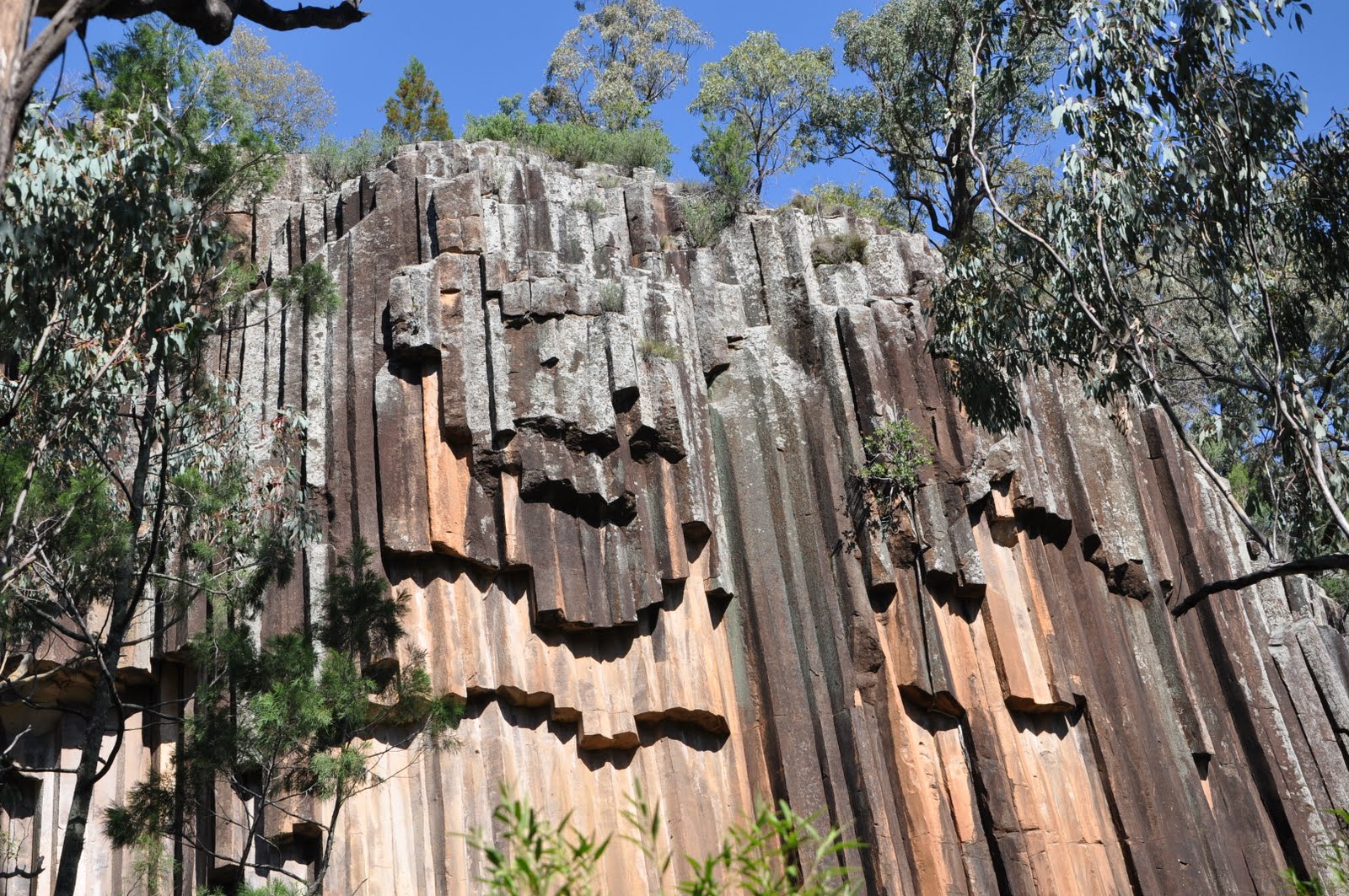
However the main reason I visited Narrabri this time was to photograph the spectacular rock formation known as Sawn Rocks. This is a 40 metre high basalt cliff face made up of octagonal shaped rocks. The whole formation resembles a giant church organ. The rocks are believed to descend another 60 metres into the earth. Some of the rocks have fallen over time and huge fragments lie in Bobiwaa Creek below. These slabs resemble the ruins of Greek temples and give the whole area a 'fairyland' appearance. Below are photos of the basalt wall and of some of the fragments in the creek below.


On the way back to Sydney I had to pass through the town of Baan Baa. Here is a photograph of the local cricket club. The bus serves as change rooms and grandstand.

This last photograph was taken on the way up to Narrabri. I travelled at night and passed by the mines near Singleton on the New England Highway while it was still dark.

Thursday, September 2, 2010

THE DISH

The radio telescope at Parkes.


July 21st, 1969. Although I sometimes have trouble remembering what I did yesterday July 21st 1969 is one of those days where I remember exactly where I was and what I was doing. How can I be sure? Well it was the day man landed on the moon.

The Apollo 11 spacecraft piloted by Neil Armstrong, Michael Collins and Buzz Aldrin was launched on July 16th and carried the astronauts to the moon and into the history books. While Collins orbited the moon Armstrong and Aldrin descended to the moon's surface touching down their landing craft, 'The Eagle' on the Sea of Tranquility. They spent 21 hours and 31 minutes on the surface and became the first humans to walk upon the moon.

I was at primary school at the time. I think in year 6. The school stopped and everyone huddled together in rooms to watch this historic event on television. Being seniors, there not being enough TVs, and my grandfather being principal, four or five of us were allowed to go to a student's house near the school and watch it there. The boy whose house we went to was Ian Holt, and I think the other students were Phillip Ewing, Nicky Perriman and Nicholas Baronoff. Like six hundred million people around the globe we did watch the moon walk on TV and we must have been so enthralled that we forgot to return to school after the event and so somehow missed the afternoon lessons.

A poster advertising the movie about the telescope.

Many years later, in 1997 I was appointed to Parkes High School in the middle of the state. Coincidentally, Parkes is the home of the satellite tracking station which relayed the pictures that I, and the rest of the world watched on that day in 1969. The part played by the telescope at Parkes (or at least a version of it) is now well known thanks to a movie made about the event and released on October 19, 2000 called 'The Dish'. I later also watched this movie on a makeshift screen in the paddock beside the historic telescope.

The telescope at Parkes was conceived by E. G. (Taffy) Bowen, then head of the CSIRO's Radiophysics Laboratory. Bowen had been involved with radar during World War II and had made many contacts overseas. He was able to convince both the Carnegie Institute and the California Institute of Technology to fund half the costs for building a telescope in Australia. The then Prime Minister, Robert Menzies, was so impressed with the involvement of these two prestigious bodies that he agreed the government would fund the other half of the project.

An historical photo showing the building of the telescope.

There seemed to be nobody in Australia with the expertise capable of building the telescope and so the CSIRO consulted with Wallis Barnes (of 'dambusters' fame) the chief engineer at Vickers in Great Britain. Wallis came up with some revolutionary ideas for the telescope and the way it was maneuvered. The design for the telescope was completed in 1959 by Freeman Fox (the company that had designed the Sydney Harbour Bridge). A contract for construction of the telescope was then awarded to the Maschinenfabik Augsburg-Nurnberg A.G. Company in Germany and the telescope itself completed in 1961. It has been operating almost continuously since this date.

The telescope as it stands today.

When the moon walk began three stations were receiving the signals back on Earth: NASA's Goldstone station in California, The Honeysuckle Creek station outside of Canberra and the CSIRO's Radio Telescope at Parkes. The signal were being relayed to NASA Mission control in Houston. For the first few minutes NASA switched between Goldstone and Honeysuckle Creek to try obtain the best images. However when they received the images from Parkes they were so superior in quality that they remained with Parkes for the rest of the telecast.

Although the movie does stretch the truth with a few details, one incident is portrayed accurately. In the movie the telescope was plagued by high winds as the walk was due to take place. The winds would be dangerous to the telescope if it was not in the upright position and strapped down. In reality the telescope dish was, at the time of the walk,tipped over on its access waiting for the first signals from the moon as it came above the horizon. Suddenly the structure was hit by 110 kilometre an hour wind gusts which shook the control room and pushed the telescope back on its zenith axis gear. It came very close to Parkes' role in the mission being aborted and the telescope being shutdown until the weather cleared. However the telescope continued to operate outside of its safety parameters but was closely monitored the whole time.

A close-up of the dish showing that it is part covered with metal plates and part mesh.


From Parkes the signal was sent by microwave links to Sydney. In Sydney the signal was split. One signal was sent to the ABC studios to be played on Australian television, the other was sent to Houston where it was distributed to television networks around the world. However the retransmitting from Houston meant there was a delay of 300 milliseconds, thus Australian audiences were the first to see the images of the walk on the moon, albeit by .3 of a second.

The telescope at Parkes is a radio telescope and listens for signals from space. Its dish is 64 metres and is moveable. It often operates in conjunction with the Australia Telescope Compact Array at Narrabri and a single dish at Mopra, near Coonabarabran. The Parkes, Morpa and Narrabri telescopes by operating together use a technique called "interferometry". This allows them to simulate a dish many hundreds of kilometres wide giving scientists the ability to see very fine detail and to form an accurate picture of an area in space in a 12 hour period.and can map a specific area of space. The telescopes are operated by the Australian Telescope National Facility, a division of CSIRO. They are operated for scientific purposes and not for military or defence purposes.

The Parkes telescope operates all year round. It has been involved in tracking space missions, including the Apollo missions in the 1960s, Mariner 2, Mariner 4, Voyager, Giotto, Galileo and Cassini-Huygens probes. It is a world centre for research into pulsars, discovering over half of those known of today. Listed amongst its other achievements are helping to identify the first quasar and discovering magnetic fields in space.

The main characters in the movie discuss problems at the dish.

The movie "The Dish" was directed by Rob Stitch. It was about three fictional staff at the telescope and their American observer during the moon mission. The characters cope with blackouts, high winds and even a love story. At one stage, in the movie, the telescopes main computer is wiped out and the observers lose track of the Apollo 11 spacecraft which they are supposed to be tracking. Scenes involving the telescope where shot on location, including the 'cricket' and the 'hayride' scenes. Other scenes were shot not in Parkes but at Forbes, a town 33 kilometres away. This was done because of the historical buildings still standing at Forbes which better suited the period being portrayed. The movie was written by Santo Cilauro, Tom Gleisner, Jane Kennedy and Rob Stitch. The main actors were Sam Neill, Billy Mitchell, Tom Long and Patrick Warburton. It was nominated for 11 awards, winning 3. The Dish was the highest grossing film in Australia in 200.

A scene from the movie where actors played cricket in the telescope's dish.

Oh...and I did say I remembered July 21st 1969. If you look up articles on the internet you will sometimes come across the date that man walked on the moon as July 20th 1969. This is American time but by Greenwich Mean Time it was July 21st. To be precise it was at 12.56pm Australian Eastern Standard Time. If it had been the 20th I may have missed it, as it was a Sunday and there was no school.

Neil Armstrong was the first man to walk on the moon, followed closely by Buzz Aldrin. How many other men have walked on the moon, and who are they? (Answer at bottom)

An attraction at the telescope and the visitor's centre is the whispering dishes. The shape of the dishes channel voice waves and makes a whisper audible to someone standing at another dish some distance away.

There have been 12 men to walk on the moon. They are:
Neil Armstrong and Buzz Aldrin (Apollo 11, July 21, 1969),
Pete Conrad and Alan Bean (Apollo 12, November 19-20, 1969),
Alan Shepard and Edgar Mitchell (Apollo 14, February 5-6, 1971),
David Scott and james Irwin (Apollo 15, July 31, 1971),
John W Young and Charles Duke (Apollo 16, April 21-23, 1972)
Eugene Cernan and Harrison Schmitt (Apollo 17, December 11-14, 1972)

.............................. of course some people still claim it is all a huge hoax and we have never walked on the moon!