Wednesday, October 6, 2010

NARRABRI AND SAWN ROCKS

The main street before sunrise.

I lived in the town of Narrabri for approximately seven years. It is located in the north west of New South Wales about 520 kilometres from Sydney on the junction of the Newell Highway and the Kamilaroi Highway. It is situated on the Namoi River, and because of this often floods as rainwater drains from several catchment areas. The population is a little over six thousand people and it is known as 'the sportiest town' according to one television morning show. Certainly when I lived there my neighbours were Olympians, Graham Windeatt and Nira Stove.

Narrabri is also home to many descendants of the Kamilaroi people who originally occupied the area before white settlement. I had a lot to do with the Kamilaroi community and even went to the World Indigenous Youth Conference in Darwin with two Kamilaroi elders and two Aboriginal youths.

Volcanic plug on the way to Mount Kaputar.

The area was once known for beef, lamb and wheat, though all of these have recently taken a back seat to cotton. Of interest in the area is Mount Kaputar, Yarri Lakes and the Pilliga Forest. Mount Kaputar, located in the Mount Kaputar National Park, is 1,508 metres high. It is the remnant of an extinct volcano and it is claimed that on a clear day a seventh of the state of New South Wales can be seen from the mountain's summit. Yarri Lakes are located between Narrabri and Wee Waa, on the edge of the Pilliga Scrub. They are a conical indentation, or three indentations, in the earth, about 3km wide which fill up with water. They are a favourite camping spot, water ski area and a breeding ground for many species of water birds. The Pilliga Forest, better known as the Pilliga Scrub, is the largest continuous woodland west of the Great Dividing Range, and span some 3,000 square kilometres. It is home to over 300 bird species and a number of endangered animals, including the Squirrel Glider, Pilliga Mouse, Rufus Bettong and the Glossy Black cockatoo.

Kangaroo and Joey. Many are found on top of Mount Kaputar.

A tourist attraction at Narrabri is the Australian Telescope Compact Array (ATCA). It consists of six 22 metre antennas while are arranged along a section of railway track. Like the telescope at Parkes they are used for radio astronomy. Located about 25 kilometres from town,the telescope is administered by the Australian Telescope National Facility. The telescope is operated all year around. About a third of the astronomers using the facility come from overseas. Astronomers usually stay at the telescope for about three days. On average two astronomers arrive and leave the facilty every day.

View of one of the antennae at nightfall.

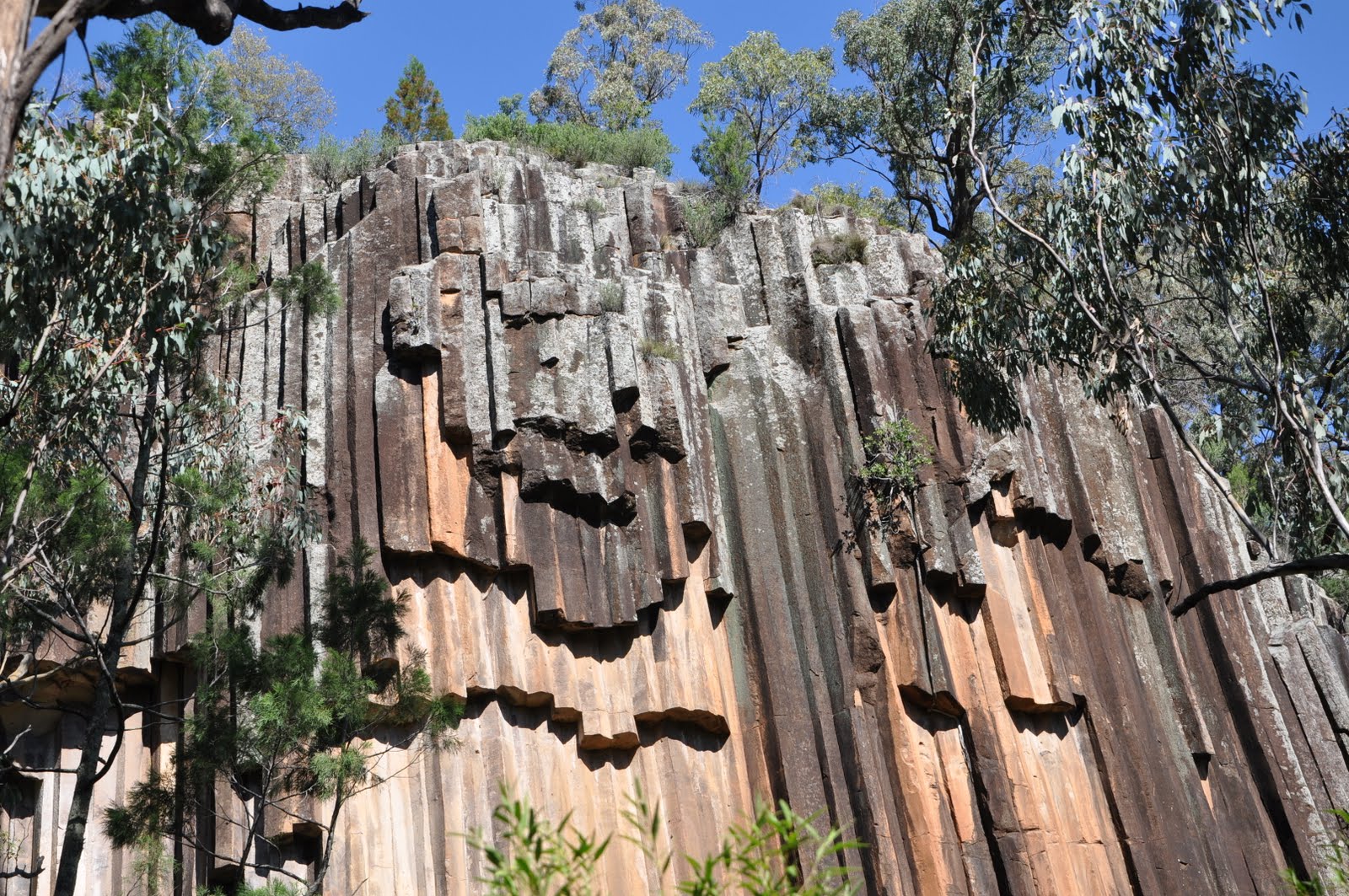
However the main reason I visited Narrabri this time was to photograph the spectacular rock formation known as Sawn Rocks. This is a 40 metre high basalt cliff face made up of octagonal shaped rocks. The whole formation resembles a giant church organ. The rocks are believed to descend another 60 metres into the earth. Some of the rocks have fallen over time and huge fragments lie in Bobiwaa Creek below. These slabs resemble the ruins of Greek temples and give the whole area a 'fairyland' appearance. Below are photos of the basalt wall and of some of the fragments in the creek below.


On the way back to Sydney I had to pass through the town of Baan Baa. Here is a photograph of the local cricket club. The bus serves as change rooms and grandstand.

This last photograph was taken on the way up to Narrabri. I travelled at night and passed by the mines near Singleton on the New England Highway while it was still dark.

Thursday, September 2, 2010

THE DISH

The radio telescope at Parkes.


July 21st, 1969. Although I sometimes have trouble remembering what I did yesterday July 21st 1969 is one of those days where I remember exactly where I was and what I was doing. How can I be sure? Well it was the day man landed on the moon.

The Apollo 11 spacecraft piloted by Neil Armstrong, Michael Collins and Buzz Aldrin was launched on July 16th and carried the astronauts to the moon and into the history books. While Collins orbited the moon Armstrong and Aldrin descended to the moon's surface touching down their landing craft, 'The Eagle' on the Sea of Tranquility. They spent 21 hours and 31 minutes on the surface and became the first humans to walk upon the moon.

I was at primary school at the time. I think in year 6. The school stopped and everyone huddled together in rooms to watch this historic event on television. Being seniors, there not being enough TVs, and my grandfather being principal, four or five of us were allowed to go to a student's house near the school and watch it there. The boy whose house we went to was Ian Holt, and I think the other students were Phillip Ewing, Nicky Perriman and Nicholas Baronoff. Like six hundred million people around the globe we did watch the moon walk on TV and we must have been so enthralled that we forgot to return to school after the event and so somehow missed the afternoon lessons.

A poster advertising the movie about the telescope.

Many years later, in 1997 I was appointed to Parkes High School in the middle of the state. Coincidentally, Parkes is the home of the satellite tracking station which relayed the pictures that I, and the rest of the world watched on that day in 1969. The part played by the telescope at Parkes (or at least a version of it) is now well known thanks to a movie made about the event and released on October 19, 2000 called 'The Dish'. I later also watched this movie on a makeshift screen in the paddock beside the historic telescope.

The telescope at Parkes was conceived by E. G. (Taffy) Bowen, then head of the CSIRO's Radiophysics Laboratory. Bowen had been involved with radar during World War II and had made many contacts overseas. He was able to convince both the Carnegie Institute and the California Institute of Technology to fund half the costs for building a telescope in Australia. The then Prime Minister, Robert Menzies, was so impressed with the involvement of these two prestigious bodies that he agreed the government would fund the other half of the project.

An historical photo showing the building of the telescope.

There seemed to be nobody in Australia with the expertise capable of building the telescope and so the CSIRO consulted with Wallis Barnes (of 'dambusters' fame) the chief engineer at Vickers in Great Britain. Wallis came up with some revolutionary ideas for the telescope and the way it was maneuvered. The design for the telescope was completed in 1959 by Freeman Fox (the company that had designed the Sydney Harbour Bridge). A contract for construction of the telescope was then awarded to the Maschinenfabik Augsburg-Nurnberg A.G. Company in Germany and the telescope itself completed in 1961. It has been operating almost continuously since this date.

The telescope as it stands today.

When the moon walk began three stations were receiving the signals back on Earth: NASA's Goldstone station in California, The Honeysuckle Creek station outside of Canberra and the CSIRO's Radio Telescope at Parkes. The signal were being relayed to NASA Mission control in Houston. For the first few minutes NASA switched between Goldstone and Honeysuckle Creek to try obtain the best images. However when they received the images from Parkes they were so superior in quality that they remained with Parkes for the rest of the telecast.

Although the movie does stretch the truth with a few details, one incident is portrayed accurately. In the movie the telescope was plagued by high winds as the walk was due to take place. The winds would be dangerous to the telescope if it was not in the upright position and strapped down. In reality the telescope dish was, at the time of the walk,tipped over on its access waiting for the first signals from the moon as it came above the horizon. Suddenly the structure was hit by 110 kilometre an hour wind gusts which shook the control room and pushed the telescope back on its zenith axis gear. It came very close to Parkes' role in the mission being aborted and the telescope being shutdown until the weather cleared. However the telescope continued to operate outside of its safety parameters but was closely monitored the whole time.

A close-up of the dish showing that it is part covered with metal plates and part mesh.


From Parkes the signal was sent by microwave links to Sydney. In Sydney the signal was split. One signal was sent to the ABC studios to be played on Australian television, the other was sent to Houston where it was distributed to television networks around the world. However the retransmitting from Houston meant there was a delay of 300 milliseconds, thus Australian audiences were the first to see the images of the walk on the moon, albeit by .3 of a second.

The telescope at Parkes is a radio telescope and listens for signals from space. Its dish is 64 metres and is moveable. It often operates in conjunction with the Australia Telescope Compact Array at Narrabri and a single dish at Mopra, near Coonabarabran. The Parkes, Morpa and Narrabri telescopes by operating together use a technique called "interferometry". This allows them to simulate a dish many hundreds of kilometres wide giving scientists the ability to see very fine detail and to form an accurate picture of an area in space in a 12 hour period.and can map a specific area of space. The telescopes are operated by the Australian Telescope National Facility, a division of CSIRO. They are operated for scientific purposes and not for military or defence purposes.

The Parkes telescope operates all year round. It has been involved in tracking space missions, including the Apollo missions in the 1960s, Mariner 2, Mariner 4, Voyager, Giotto, Galileo and Cassini-Huygens probes. It is a world centre for research into pulsars, discovering over half of those known of today. Listed amongst its other achievements are helping to identify the first quasar and discovering magnetic fields in space.

The main characters in the movie discuss problems at the dish.

The movie "The Dish" was directed by Rob Stitch. It was about three fictional staff at the telescope and their American observer during the moon mission. The characters cope with blackouts, high winds and even a love story. At one stage, in the movie, the telescopes main computer is wiped out and the observers lose track of the Apollo 11 spacecraft which they are supposed to be tracking. Scenes involving the telescope where shot on location, including the 'cricket' and the 'hayride' scenes. Other scenes were shot not in Parkes but at Forbes, a town 33 kilometres away. This was done because of the historical buildings still standing at Forbes which better suited the period being portrayed. The movie was written by Santo Cilauro, Tom Gleisner, Jane Kennedy and Rob Stitch. The main actors were Sam Neill, Billy Mitchell, Tom Long and Patrick Warburton. It was nominated for 11 awards, winning 3. The Dish was the highest grossing film in Australia in 200.

A scene from the movie where actors played cricket in the telescope's dish.

Oh...and I did say I remembered July 21st 1969. If you look up articles on the internet you will sometimes come across the date that man walked on the moon as July 20th 1969. This is American time but by Greenwich Mean Time it was July 21st. To be precise it was at 12.56pm Australian Eastern Standard Time. If it had been the 20th I may have missed it, as it was a Sunday and there was no school.

Neil Armstrong was the first man to walk on the moon, followed closely by Buzz Aldrin. How many other men have walked on the moon, and who are they? (Answer at bottom)

An attraction at the telescope and the visitor's centre is the whispering dishes. The shape of the dishes channel voice waves and makes a whisper audible to someone standing at another dish some distance away.

There have been 12 men to walk on the moon. They are:
Neil Armstrong and Buzz Aldrin (Apollo 11, July 21, 1969),
Pete Conrad and Alan Bean (Apollo 12, November 19-20, 1969),
Alan Shepard and Edgar Mitchell (Apollo 14, February 5-6, 1971),
David Scott and james Irwin (Apollo 15, July 31, 1971),
John W Young and Charles Duke (Apollo 16, April 21-23, 1972)
Eugene Cernan and Harrison Schmitt (Apollo 17, December 11-14, 1972)

.............................. of course some people still claim it is all a huge hoax and we have never walked on the moon!

Tuesday, August 3, 2010

TARONGA ZOO


Twice in the last week I have visited Taronga Park Zoo. My purpose has been to learn to use a telephoto lens and to practice using the setting on a digital SLR camera. The camera is a Nikon D90 and it has three lens. The main lens is a Nikkor AF-S DX 18-105mm F/3.5-5.6G ED VR. The second lens is a macro lens for shooting very small things. It is a Tamron SP AF90mm F/2.8 Di Macro 1:1. The third lens is the telephoto, and the one I am trying to learn to use correctly. It is a Sigma 150-500mm F/5-6.3 APO DG OS HSM. Each lens has an ultra violet filter on it.

So what does all this mean? Well I guess it means I have a lot to learn because I know very little about these lens and my job is to learn how to use them. They do take splendid pictures, almost without me.

One of the first enclosures is that with the giraffes. This giraffe I am sure knew that it was my first time with the camera and is almost smirking over the top of the enclosure.

The chimps make a good subject matter, especially the young who are always finding some antic to get up to. This photo was taken through the glass.

There are over two and a half thousand individual animals at Taronga Zoo. The zoo is spread over 21 hectacres and after a report on the zoo in 1967 it updated many of its facilities and got rid of "attractions" such as the elephant ride and the merry-go-rounds. Pictured about is one of these animals, the Binturong, commonly known as the Asian Bearcat. It is neither a bear or a cat but belongs to the a family similar to the better known civet. The Bearcat is nocturnal and lives in trees in rain forests across Asia. The Bearcats' enclosure at Taronga allows the visitor to get so close that they can almost reach out and touch the animal. Its diet consists of fruits, insects and small animals. The keeper told me that they only became dangerous if you tried to pick one up or if the animal felt threatened.

One of the new enclosures built in response to the 1967 report was the walk-through rainforest. A pair of Red Lory parrots were breeding in one of the walk-through bird enclosures. Its nest was under a rock where it had dug out a tunnel. The young had only recently left the nest. The Red Lory comes from Indonesia. Pheasants, doves and quails also shared this enclosure.

Meerkats have become very popular zoo exhibits. Some people stand and watch their antics for hours. While one of their number stands watch the others forage for food, dig in the sandy soil or sun themselves.

The sea lion and seal enclosures were interesting places for taking photographs. Inevitably the inquisitive animals come to the surface to investigate what you are doing. A challenge in the future will be to try to photograph these animals while they are swimming. This can be done through the glass viewing windows which give an amazing view of the animals world beneath the water.

Pictured are some wild Rainbow Lorikeets who live in the area and visit the zoo picking up scraps left by the bigger animals in their enclosures. Taronga Zoo was officially opened in 1916. The name Taronga is an Aboriginal word meaning 'beautiful view'. This is still true today. Located at Mosman the zoo has wonderful views of the harbour, the Harbour Bridge and the Opera House. These views are even more evident now as visitors can ride above the zoo in a cable car.


The Red Panda is not as recognizable as the traditional black and white animal. They would still make cute pets. It is about the size of a large cat and is often known as 'the shiny cat'. It comes from the Himalayas in Nepal and China. There may be as few as two and a half thousand individual animals left in the wild.

Tigers always make dramatic pictures. This is probably because they are so powerful. This one almost looks like it is posing for the camera.

Each afternoon the zoo has a bird show where eagles, owls and parrots fly in to the arena. The finale is to be seen to be believed! The Black-breasted Buzzard, pictured above, is native to Australia. It uses a rock to break open emu eggs. Those used in the demonstration are not real emu eggs.

Here is another bird used in nthe open air bird show. This was shot using the sports function on the camera, so everything is captured in a snap except the extremely fast moving wings.

Barbary sheep are natives of Northern Africa. However they are difficult to find there now. There numbers are thriving in southern Europe and America where they were introduced.

Zebras are a popular animal. It was interesting trying to photograph them as their lines played havoc with the focus system in the camera, it kept zeroing in and out unable to focus. However when it does focus the zebra does take a nice photograph.

This is probably my favourite photograph. The Indian myna bird is an introduced species to Australia and in many places they are considered a pest. This bird was scrounging food around the zoo. It stopped and sat up nicely for me. Maybe it is the contrasting colours which make it such a nice photograph.

Gorillas are always interesting. It is probably their human-like qualities that make us so fascinated by them.


I spent some time photographing the lions. Using the telephoto lense pressed against the class, and being there at feeding time, really produced some good close-up photographs.

The zoo was a good place to start using a camera because the opportunities for good pictures are so frequent. Now I need to work on making them technically better. If youn would like to see some superb photographs taken at the zoo there is currently a free exhibition being held at Parliament House in Sydney. It features zoo photographs by Rick Stevens. Rick was a photographer with the Herald for a period spanning over forty years. During this time he spent many, many hours at the zoo patiently waiting for the perfect shot. The exhibition finishes on 26 August.

Sunday, August 1, 2010

SIBERIAN HUSKY DOG RACES


Wow! What a terrific sport or hobby.

Last weekend I went to the sled dog races held in Wingello State Forest by the Siberian Husky Club of NSW. I drove down from Sydney to the small village of Wingello early on Sunday morning. After a few false starts I saw some car lights disappearing into the distance and as that was the only movement at that hour of the morning I set off along a windy, dirt road in the same direction the other car had gone. After driving several kilometres I was starting to think I wasn't going to find anyone. Then I found a huge banner (pictured above) and knew I arrived at the right place.

As it was still dark I was worried about driving into the camp as I might wake people. So as quietly as I could I coasted along the road. I need not have worried because I soon heard the sound of dogs barking and howling. As there were approximately 150 dogs and it seemed most of them were greeting the morning I doubted that anyone in the camp was able to sleep.


A dog team rests after finishing their race.

I parked the car and wandered around the camp. I talked to people out walking their dogs, plastic bag in hand. I learnt about the different types of races, the care and training of the dogs, the conditions for racing and the types of races.

The first set of races were the six and four team dog sleds. These raced over a shortened track of about 5 to 6 kilometres as it was expected the day was going to get a little hot at about 11 degrees. I was amazed at how well organised the races were and especially at how keen the dogs were to race. At the start line the dogs became very excited and continually pulled at the leash wanting to begin.

A team receives a watering before its race to avoid dehydration.


Teams were sent off at regular intervals and the results were based on the times they took around the bush track. The dog teams were controlled by the driver, or musher, as they are called, using only voice commands. "Gee" means turn left; "haw" means turn right; "hike" means to go faster while "on by" means to pass a distraction or road turning. It quickly became evident how well trained and responsive to these commands the dogs were. At the start of the race the course passes a track off to the left. Some of the dog teams started to veer towards this track but a short, sharp word from the musher made the dogs instantly respond and stay on the course.

The dogs ideally have speed and endurance and can run at average speeds of about twenty kilometres an hour or more. The four and six dog teams pull a cart or rig. Some carts have four wheels while others have three. The two dog teams and single dogs pull a scooter. These scooters are very similar to the ones children use but larger.

A well trained six dog team patiently awaits the beginning of the race.

A six dog team nears the finish line


Husky racing began in Alaska, where sled teams were used to move supplies to gold miners in remote locations. Although many challenge races took place between rival 'company teams' it wasn't until the early 1900s that the first organised race took place. The sport gained in popularity once it spread to the USA and today there are over 200 Sled Dog Racing Clubs around the world.

The sport has grown in Australia over the past twenty years. Although it has some dedicated participants in NSW it is particularly strong in Victoria and even stronger in South Australia at the moment. South Australia holds 'race meetings' nearly every weekend during the winter.

A two dog team is held ready to start their race. If not held the dogs enthusiastically take off too soon.


Sled dog racing is strictly a winter sport as the dogs can only race when the weather is cool or they over-heat. NSW Club has a strict rule where race meetings are called off once the temperature reaches 15 degrees. At this race meeting the race distance was shortened as the day was warmer than the organisers like. Races are always held early in the day, or sometimes at night, when it is coolest.

Donovan begins a race with a two dog team.


Race days are very much family affairs. There are both men and women drivers. There are junior races and even a pee wee race for the real young, who are accompanied by a parent controlling the dog team. I spoke to Donovan,a 'musher', who spoke of his dog team with obvious pride. He told me he had ridden motor bikes and his wife had been the one who began driving the dog teams. However when she became pregnant he reluctantly took over the handling of the team. He says he now prefers it to motor bike racing.

The couple had sold their beach front house and moved to a small property on the edge of Sydney purely for the benefit of the dogs. They were now also heavily involved in 'husky rescue'. This is where they save husky dogs from the pound and find new homes for them after having the dogs desexed and micro chipped.

Another two dog team. This time pulling a cart.


Another musher told me how he used to be a professional bull rider. He talked about the friendly nature of the sled dog competitions. While races were always good natured and very friendly everyone was competitive and wanted to improve their times and places. He trained his teams four times a week but reduced this during the racing season so as not to wear out the dogs. It was obvious after every race it was the dogs that were always looked after first before the driver or the handlers.

There was a considerable amount of skill exhibited by drivers as they negotiated sharp corners with their dogs.


While any dog can be used in the sled races most stuck with tradition and had teams of Siberian or Alaskan huskies. However there were also some teams which used hounds because of their strength. I was also told of one lady who was pulled by a Staffordshire terrier.

Most riders seemed to have developed their own style. Some stood, while some preferred to stop wind drag by crouching.


Care of the dogs is a priority to the owners and the organisers. Dogs were watered before races and looked after immediately after a race. There was a lot of discussion about diet and what was being fed to the dogs. Races were held at a time which best suited the dogs, and if it became too hot the races were called off. Dogs are not allowed to race or pull a sled until they are nearly a year old. All of the dogs I saw were extremely healthy and well cared for. The dogs also seemed very keen to run. Actually on the day I only saw one dog who a hundred yards into the race decide it wanted to stop and smell the flowers.

Towards the end of some races it wasn't always clear who was doing the pulling.


The families who were participating really deserve a pat on the back. This was a sport that was well managed, and well organised. It was fun and the dogs certainly well cared for and loved. There are two more races left in this racing season. The first is in Canberra and the second, a longer race, up in the snow. I hope to get to both these meetings, but there is always next season. I recommend everyone should go and see a race. The owners were very welcoming and ready to share their love of the animals and the sport.

.....and the last word should go to the real stars on the day.